Posts

Image
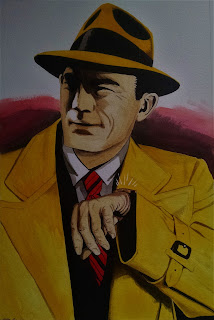
  LEGENDARY HEROES #10 DICK TRACY Chester Gould (1900-1985) was born in Pawnee, Territory of Oklahoma before it became a state.  All four of his grandparents were pioneer settlers in Oklahoma and Chester was the son of a minister of the United Brethren Church.  Gould moved to Chicago to attend art classes at the Art Institute and Northwestern University, then went to work for local Chicago newspapers where he did advertising art and comic strips.  In 1931 Gould had the idea of creating a police comic strip that would feature a modern day American Sherlock Holmes, who would be tougher than the criminals he tangled with, a cop who would shoot first and ask questions later.  It was a lawless time in America, with Prohibition and the Depression at the same time, and no place was as lawless as Chicago.  So Gould created a strip titled "Plainclothes Tracy" and submitted it to the Tribune.  Joseph Medill Patterson suggested the name change "Dick Tracy" and th...
Image
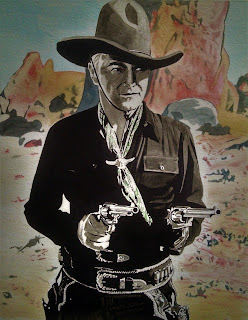
  LEGENDARY HEROES #9 HOPALONG CASSIDY Hopalong Cassidy was created in 1904 by author Clarence E. Mulford.  Mulford was born in Streator, Illinois and wrote 28 novels and numerous short stories about Hopalong and the Bar 20 Ranch.  The first story appeared in "Outing" magazine in 1904, and the last appearance was his 1941 novel "Hopalong Cassidy Serves a Writ".  The character of "Hoppy" was a grubby, irritable, foul-mouthed, crusty old coot who had a wooden leg  that caused him to "hop", hence his nickname.  The literary Cassidy was nothing at all like the film version that popularized him.  The film series began in 1935 with William Boyd playing Hopalong as a clean-cut hero who never drank anything stronger than sarsaparilla.  Whether he was driving a herd of cattle for the Bar 20 or lending a helping hand to those in need, Hopalong Cassidy was always on the side of the righteous.  There were no other actors who portrayed Hopalong which made...
Image
  LEGENDARY HEROES #8 THE CISCO KID The Cisco Kid was created by O. Henry in his 1907 short story "The Caballero's Way" from the book "Heart of the West" and the July 1907 issue of Everybody's Magazine.  In the original story The Cisco Kid was not the hero that we know him to be today.  He was a 25 year-old murderous desperado who killed for sport and was responsible for 18 deaths.  The Kid was so cold-hearted that when a Texas Ranger gets on his trail, he sets up his own duplicitous girlfriend to be killed by the Ranger to make good his escape.  "The Caballero's Way" was filmed in 1914 as a silent film, which to my knowledge, no longer exists.  I don't know how faithful to the story the film was, but the depiction of Cisco as a heroic figure came in 1928 when actor Warner Baxter played the character in the film "In Old Arizona".  Baxter's portrayal won him the Oscar for Best Actor, though he almost didn't get the chance t...
Image
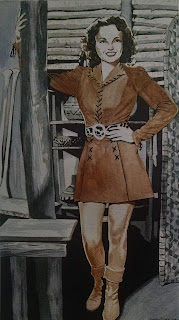
  LEGENDARY HEROES #7 NYOKA, THE JUNGLE GIRL The creation of "Nyoka, the Jungle Girl" is an interesting one.  Republic pictures released a 15-chapter serial in 1941 titled "Jungle Girl" that gave partial writing credit to Edgar Rice Burroughs of Tarzan fame.  Burroughs' short story "The Land of Hidden Men" was published in the May 1931 issue of the pulp Blue Book.  Burroughs expanded his own short story into the Lost World novel "Jungle Girl" published in 1932.  The novel was set in Cambodia and the title character was an Asian princess named Fou-Tan.  The novel bears no resemblance to the 1941 movie serial, nor is there any character in the novel named Nyoka.  The only similarity is the title "Jungle Girl" which resulted in a writing credit for Burroughs.   The serial "Jungle Girl" had as it's heroine Nyoka Meredith, a white woman living in Africa and starring Frances Gifford in the title role.  Filming took place fro...
Image
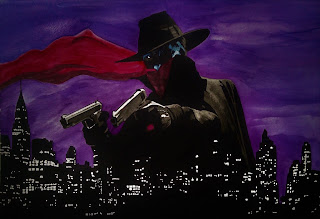
  LEGENDARY HEROES #6 THE SHADOW Street & Smith was the country's oldest and largest publisher of pulp magazines.  One of their titles, Detective Story Magazine, was experiencing declining sales.  In an effort to boost sales Street & Smith decided upon a radio show that would promote the pulp.  The publishers enlisted an ad agency and a writer-director to adapt stories from the magazine into a radio series.  The creative team hit upon the idea of having the stories narrated by a mysterious storyteller with a sinister voice.  Seeking an appropriate name for the mysterious narrator they came up with The Shadow.  On July 31, 1930, the Detective Story Hour debuted on radio with veteran voice actor Frank Readick supplying the hauntingly sibilant narration.  Radio listeners were thrilled and the program became a national sensation.  The show aired on Sunday evenings at 5:30 and listeners were soon demanding from their local news dealers cop...
Image
  LEGENDARY HEROES #5 BUCK ROGERS IN THE 25TH CENTURY Buck Rogers was America's first popular science fiction hero.  Created by Philip Francis Nowlan (1888-1940) in the novella "Armageddon 2419 A.D.", it appeared in the August 1928 issue of the pulp magazine Amazing Stories.  Nowlan followed up with a second installment titled "The Airlords of Han" that was published in March 1929.  The two novellas told the story of Buck Rogers, a veteran of WWI who, in 1927, is working for the gas company and investigating abandoned coal mines in Pennsylvania.  Buck is trapped in a cave-in and exposed to radioactive gas that puts him into a state of suspended animation.  When he awakens 492 years later he discovers a far different world than the one he remembered.  His first encounter is coming to the aid of a woman, Wilma Deering, who is fighting off a gang of attackers known as the Bad Bloods.  Wilma is part of a rebel uprising, along with Dr. Huer, that is in...
Image
LEGENDARY HEROES #4 IN A SERIES TAILSPIN TOMMY The period of the late 1920's through the 1930's became the heyday of pulp fiction.  At the peak of it's popularity over 200 magazines were published monthly reaching an audience of 10 million readers, with more successful titles selling up to a million copies per issue.  Publishers explored every popular category and genre in an effort to appeal to fans, from westerns and mysteries to romance and science fiction.  The golden era of the pulps coincided with the glory days of aviation, fueled by public interest in stories of WWI ace Eddie Rickenbacker and his memoir "Fighting the Flying Circus", and Elliot Spring's book on WWI combat flying "Nocturne Militaire".  But the major influence on the country's fascination with flying was the successful 1927 solo flight across the Atlantic by Charles Lindbergh in his plane The Spirit of St. Louis.  More than 40 pulp magazines - known as flying pulps - were de...