Posts

Image
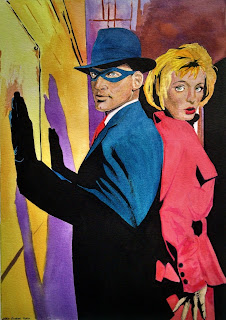
  LEGENDARY HEROES #48 THE BLACK HOOD MLJ Comics was founded in 1939 by Maurice Coyne, Louis Silberkleit, and John Goldwater.  The initials of their first names formed the MLJ of the company name.  They started out publishing superhero comics and one of the most popular characters was the Black Hood, created by Harry Shorten and premiering in Top Notch Comics #9 in October 1940.  The character was so popular that it soon began appearing in a pulp magazine.  This was an unusual twist in that several pulp heroes like The Shadow and Doc Savage made the transition to comic books, but not the opposite.  Black Hood Detective appeared as a pulp in September 1941, and was renamed Hooded Detective with the next issues in November 1941 and January 1942, before ceasing publication.  All three pulp novels of the Black Hood were authored by G. T. Fleming-Roberts, a well established pulp writer.  Despite the short run in the pulps, the Black Hood gained in popu...
Image
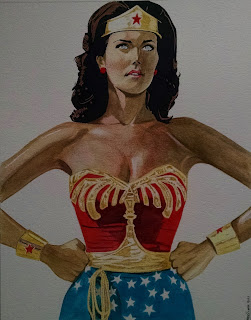
  LEGENDARY HEROES #47 WONDER WOMAN In an October 1940 article in Family Circle magazine, psychologist William Moulton Marston discussed the unfulfilled potential of the comic book medium.  Max Gaines of DC Comics saw this article and hired Marston as an "educational consultant" for DC.  Marston was already famous for inventing the polygraph machine and decided to create a new type of hero who would triumph over evil, not with fists, but with love.  His wife Elizabeth said, "Fine, but make her a woman".  Marston pitched the idea to Gaines who gave him the go-ahead, and Wonder Woman was born.  She was an unconventional hero, a liberated woman with the character and strength of Superman but with the allure of a beautiful woman.  Marston's personal situation played a role in his creation, as he based the resemblance of Wonder Woman upon his wife Elizabeth and their "life partner" Olive Byrne.  His stories also included his ideas on DISC theory - Domi...
Image
  LEGENDARY HEROES #46 PHANTOM LADY One of the first super heroine characters of the Golden Age, Phantom Lady was produced for Quality Comics by the Eisner-Iger Studio and drawn by Arthur Peddy.  Phantom Lady made her debut in Police Comics #1, August 1941, in the same issue that saw the first appearance of Plastic Man by Jack Cole.  Phantom Lady was the alter ego of Sandra Knight, a beautiful Washington, D.C. debutante and daughter of a U.S. Senator.  Her outfit which consisted of a green cape and a yellow one-piece bathing suit, was a deliberate tactic to distract her male foes.  She used a "black light projector" to blind her enemies and make herself "invisible", and drove a car whose headlights would also project black light when needed.  Sometimes she was assisted in her fight against criminals by her fiance Donald Borden, an agent of the U.S. State Department.  Phantom Lady appeared in Police Comics until October 1943. After Quality stopped publi...
Image
  LEGENDARY HEROES #45 BLACKHAWK Blackhawk was a long-running comic book series first at Quality Comics and later at DC.  The character was primarily created by Chuck Cuidera with additional assistance from Bob Powell and Will Eisner.  The exact nature of the individual contributions of Eisner, Powell and Cuidera will never be known, though credit was sometimes contentious between Eisner and Cuidera, each of them taking major credit at different times.  Blackhawk debuted in Military Comics #1 in August 1941 and was given it's own title in the Winter 1944.  Blackhawk ran in Military Comics (later renamed Modern Comics) until issue #102 in October 1950.  When Cuidera joined the service in 1942 (Eisner was drafted as well) Reed Crandall took over the art beginning a long association that would last until 1953.  Crandall, one of the great comic illustrators, turned Blackhawk into a classic and it was during this time that Blackhawk hit it's sales and popul...
Image
  LEGENDARY HEROES CAPTAIN AMERICA In 1940 writer Joe Simon came up with the idea of Captain America and drew a rough sketch of the character.  Beneath it he wrote "Super American", but thought there were too many heroes with Super in their name.  Captain America had a nice ring to it and Simon opted for that.  Martin Goodman, publisher of Timely Comics, gave Simon the go-ahead for a solo comic book series to be published ASAP.  Simon turned to his regular partner, artist Jack Kirby, and the two of them produced the contents of an entire comic book.  Captain America #1, cover dated March 1941, went on sale December 20, 1940 and sold almost a million copies.  This was one year before America was drawn into the Second World War and the cover of the comic book showed Captain America punching Hitler in the face.  While most readers responded favorably some took objection.  Simon and Kirby received threatening letters and hate mail.  One must...
Image
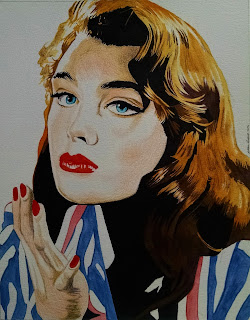
  LEGENDARY HEROES #43 BRENDA STARR, REPORTER Eternally 23 years old, Brenda Starr the "girl reporter" spent decades solving murders and mysteries, capturing jewel thieves, and thwarting international spies.  As a reporter Brenda mixed hot copy with high fashion and was always the most glamorous woman in the room.  As WWII raged Brenda parachuted into action without mussing a single red hair.  She would eventually marry the mysterious Basil St. John, an eye-patched scientist who, without regular injections of a "black orchid serum" from the Amazon, would die. Brenda Starr was the creation of Dale Messick who was born in South Bend in 1906.  At age 28 she left her hometown of Hobart, Indiana and struck out for New York City and a career in comics.  She had spent a year at Chicago's Art Institute and a summer painting bathing beauties on oilcloth tire covers, and for the first few months in NYC she survived by designing greeting cards.  The comic strip b...
Image
  LEGENDARY HEROES #42 THE SPIRIT It has been said of Will Eisner that he was to comics what Orson Welles was to cinema.  Eisner was the most important artist-writer-creator in the Golden Age of Comics, and he was responsible for the creation of The Spirit, Blackhawk, Sheena, Doll Man, and a dozen others all by the time he was 22 years old.  Will Eisner was born in 1917 to Jewish immigrants in Brooklyn.  His first comic appeared in WOW magazine in 1936, the same year that he graduated from high school.  In 1938 he started a studio with Jerry Iger - the Eisner-Iger Studio - which they started with $15.  Will financed the venture so his name came first and pretty soon they were flourishing.  They created original comic art for comic book publishers who didn't want to employ a stable of artists and writers.  Eisner-Iger Studio made a lot of money.  They were producing all of the content for Fiction House comics as well as some for Quality Comics...